
Computational Fluid Dynamics (CFD)
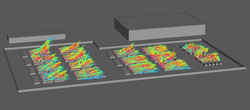
Battery Energy Storage Systems
Objective: Ensure BESS operates below threshold temperatures while at critical distribution loads.
Impact: Mitigated site failures during hot summer days, fines due to contractual performance issues and post-construction retrofits.
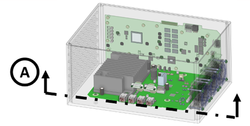
Electrical Enclosure
Objective: Ensure enclosure stays within warranty and threshold temperature ratings during standard and peak operation.
Impact: Improved thermal margins during worst-case conditions without time-consuming testing while mitigating warranty exposure and protecting brand recognition.

Water Treatment Tank
Objective: Ensure proper exposure time of chemicals within the waste-water for adequate disinfecting prior to tank construction.
Impact: Showcased tank would meet the required exposure times while maximizing total throughput of the system for increased output metrics.
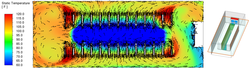
25,000ft Data Center
Objective: Assess rack and room-level airflow characteristics under critical IT loading conditions to avoid hot-air recirculation, equipment overheating and excessive room pressurization.
Impact: Mitigated rack failures and equipment deration to ensure IT infrastructure efficiency and uptime.
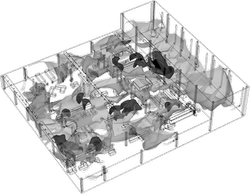
Welding Facility Fume Extraction HVAC
Objective: Compare air dispersion within the space given various ducting strategies to uncover the most effective means of removing weld fumes in a facility HVAC upgrade.
Impact: Produced a duct layout resulting in 40% less weld fume concentration with lower ACH requirements, thus creating a safer environment with lower ongoing utility costs .
Finite Element Analysis (FEA)
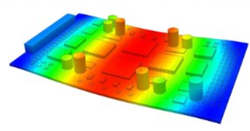
PCB Board Shock and Vibe
Objective: Compare various packaging techniques to ensure PCB will withstand typical shock or vibrational loading conditions during transit.
Impact: Anticipated and addressed failure modes non-destructively while avoiding potential for shipping damage and costly replacement parts.
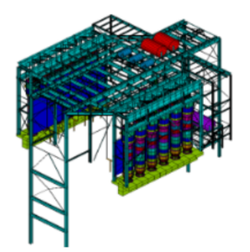
Structural Platform Seismic Loading
Objective: Assess structural integrity of proposed platform design prior to finalizing construction documentation to ensure compliance with ASCE 7 criteria.
Impact: Simulation-driven design modifications resulted in code compliance and improvement in construction simplicity and cost reduction.
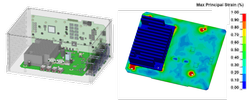
Enclosure Drop Test
Objective: Ensure that the modularized system can survive a 5-ft drop during installation and maintenance procedures given the weight of the onboard heat sink.
Impact: Illustrated the root-cause of a PCB fracture during impact along with the enclosure support modifications needed to address and alleviate future risk of failure.
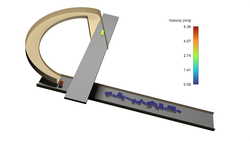
Package Handling Line DEM
Objective: Use physics-based modeling to ensure, with 99% confidence, products would neither bind nor collide given the proposed line layout and speeds.
Impact: Validated package movement efficiency with 99.7% confidence, thus mitigating damaged product and expensive line fabrication retrofits.
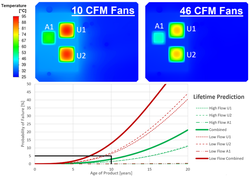
Electronics Reliability of GPU/CPU Enclosure
Objective: Uncover the enclosure design strategy needed to ensure the thermal and structural product lifespan exceeds 10 years with 95% certainty.
Impact: Achieved a 12-year life span prediction given an informed redesign of support structures and fan size/locations while reducing BOM cost and time to market.
Electromagnetic Field Simulation (EMAG)
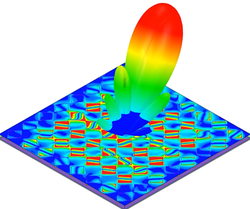
Antenna Design
Objective: Optimize antenna design features and placement for proper match across band of operation and to maximize antenna gain/efficiency.
Impact: Identified optimal design with 60% fewer prototypes and stronger understanding of antenna performance.
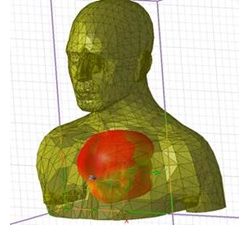
Implant BLE Antenna Range Optimization
Objective: Optimize antenna gain and impedance matching to minimize transmission losses through human tissue.
Impact: Achieved embedded BLE transmission link greater than 1.5m with refined antenna structure.
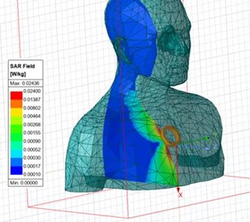
Implant Charging SAR Analysis
Objective: Represent real-life implant charging scenario and confirm Specific Absorption Limit (SAR) within allowable safety limits.
Impact: Regulatory submission supported by simulation results given the understanding of charger misalignment impacts on power transfer efficiency and tissue heating.
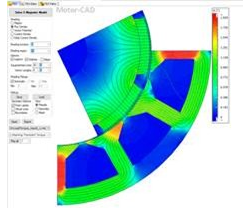
Electric Machine Optimization
Objective: Optimize existing motor design to achieve greater speed/torque output.
Impact: Doubled rated power output with minimal increase to motor size while also increasing overall motor efficiency by 12% across expanded operating range.
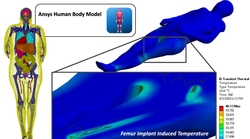
Wireless Transmitter MRI Compliance
Objective: Gain confidence in implant’s performance against ASTM F2182 (RF heating) and ISO 10974 (Torque from MRI magnetic field) to ensure patient safety.
Impact: Avoided costly redesign of neuromodulator device and delayed product design schedule.
Optics & Photonics
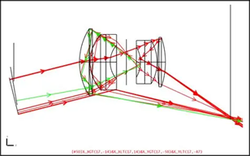
Optical Assembly Stray Light Analysis
Objective: Confirm cross talk between optical fibers caused by stray light scattering/diffraction was below 10 dB to avoid performance degradation.
Impact: Validated feasibility ahead of design freeze while mitigating interference that would produce signal distortion, reduced data rates and communication failures.
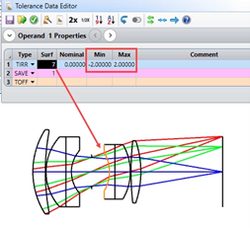
Laser Controller Module
Objective: Conduct tolerance analysis on the optical mounts DOF to properly align lasers and produce a collimated beam.
Impact: Eliminated physical testing costs, reduced mirror fabrication cost by 15% and introduced a systematic workflow repeatable for other modules.
